
St. Lucie VINELink Release Coverage
Florida's service is VINE, short for Victim Information and Notification Everyday. The public interface is VINELink. Florida sources identify FDC, the Department of Juvenile Justice, and participating county jails as custody systems in the network. That makes the service relevant to a St. Lucie County Jail record and to an FDC prison record. Facility participation and the current interface still must be checked for the specific person.
Coverage does not make the systems interchangeable. A person who leaves St. Lucie County Jail for FDC has left county custody but has not entered the community. Someone departing Fort Pierce Community Release Center may still be in FDC custody until the offender record shows discharge. Youth information can also be restricted. VINELink reports the status supplied by a participating agency, while the Sheriff, FDC, or authorized juvenile source controls the underlying record.
The Florida VINELink entry shows the state search path. Its interface is meant for a person check and notification registration, not for browsing a historical county release list.
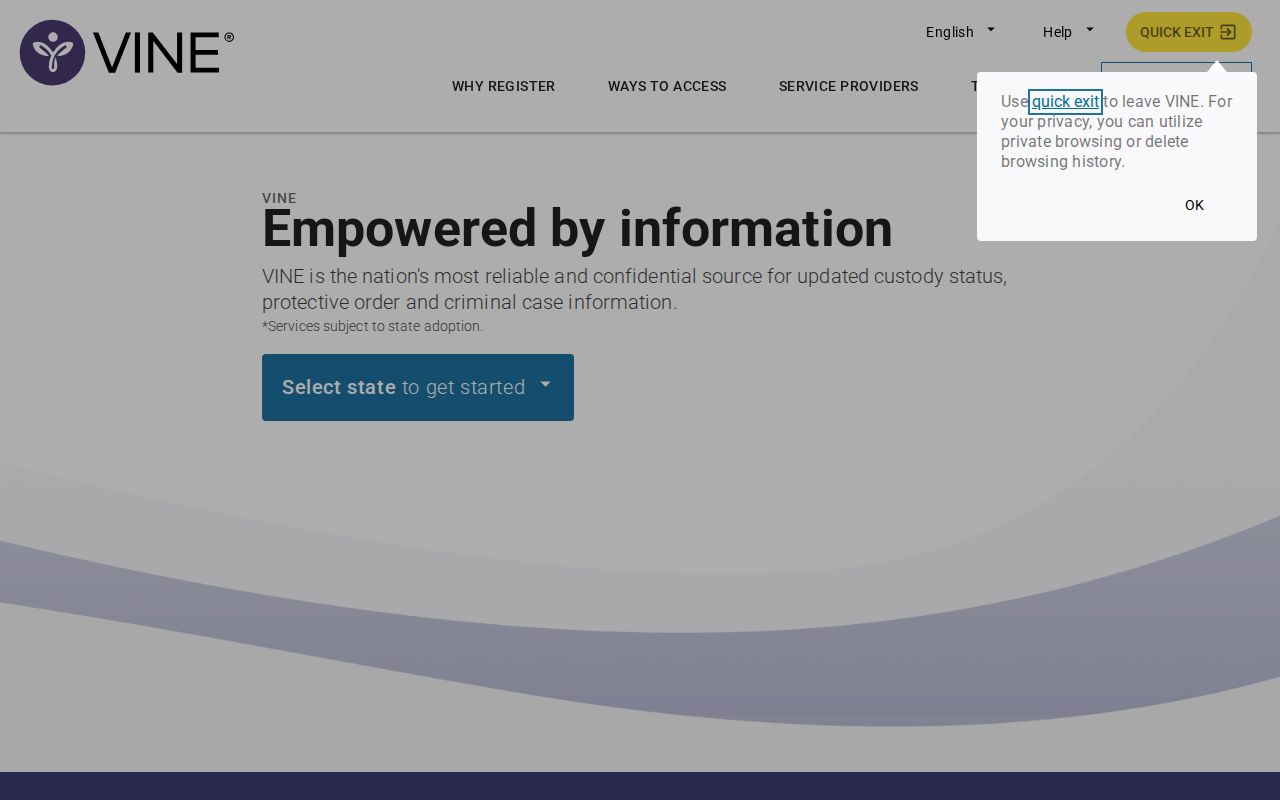
The captured search screen documents the proper Florida starting point without making a private person's record the focus.
Search a St. Lucie Inmate
Use the fullest verified identity information available. A common name can return more than one record, while spelling and aliases can hide the right match. A Sheriff profile, court case, or FDC detail may supply an inmate number, DC number, date of birth, or facility. These fields are far safer than selecting a result by name alone.
- Open the Florida state entry and select the offender or custody search.
- Enter the verified name or an available identifier. Use aliases shown on an official jail or FDC record when needed.
- Compare date of birth, inmate or offender number, agency, facility, and any other identity fields displayed.
- Open the matching result and read the exact custody-status wording and location.
- If the record says released or out of custody, confirm the date and destination with the agency that supplied the data.
- When transfer is possible, search the receiving system. County release to FDC or ICE is not community release.
For a local jail case, compare VINELink with the SLCSO release report or the booking and release record. For a state sentence, compare it with FDC's Release Date, Date Out-Custody, custody history, and supervision detail. The St. Lucie County released inmate record path covers the source checks needed after the alert or result appears.
Note: A recently released name may remain in the Sheriff's five-day search even though the person is no longer in jail custody.
St. Lucie VINELink Release Fields
The fields shown can vary with the participating source. Read only what the result actually states. “Released” or “out of custody” means that the source reported a change, not that VINELink independently decided the legal outcome. A facility name can help trace a transfer. An identifier can connect the alert to a Sheriff or FDC record. The underlying release record remains the durable proof.
| Field | What it can establish |
|---|---|
| Name | The reported person, subject to spelling and alias checks |
| Offender or inmate ID | A stronger match to the source custody record |
| Custody status | The status last reported by the participating agency |
| Facility or agency | The source or reported custody location to contact |
| Release or change information | A reported event that should be checked against SLCSO or FDC |
A released result does not state the whole destination story. A person may have gone home, entered supervision, moved to another jail, entered state prison, or transferred to immigration authorities. Use the case and agency trail. BOP custody requires the federal locator, while ICE custody requires its own locator. VINELink is not an archival certificate for either federal system.
SLCSO Links Release to VINELink
St. Lucie has a direct local integration that is more useful than a generic national link. An observed released SLCSO inmate profile kept a populated Released timestamp and placed a “Victim Information & Notification” link beside the custody information. The Sheriff's victim-rights brochure also names Florida VINE and states that registration is required. This bridge ties the local booking record to the statewide alert service.
The documented released SLCSO profile shows how the local timestamp and the notification link can appear together. A profile is a live public record and may change, so its labels should be read on the day of the check.
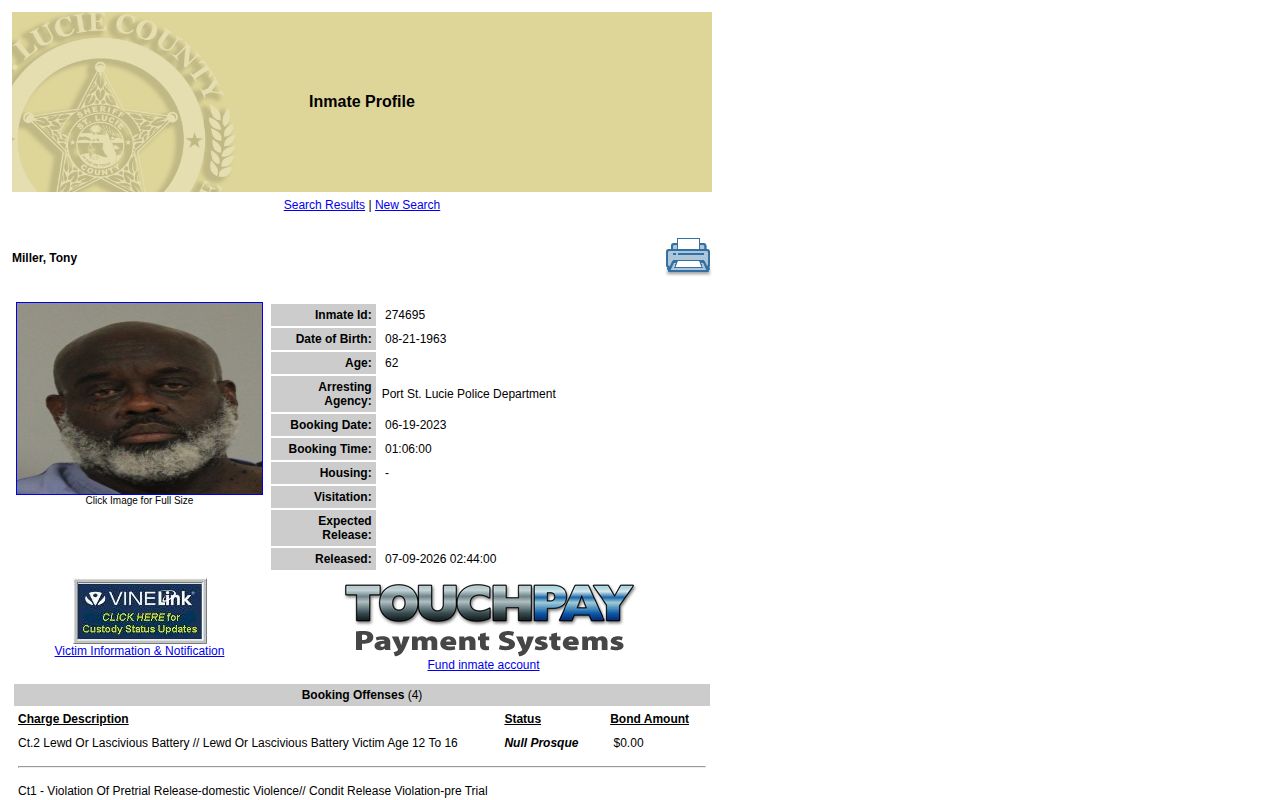
The screenshot confirms the county-specific handoff: SLCSO supplies the exact local release field, while VINELink supplies the notification route.
This link still does not merge the records. Use the Sheriff's release timestamp to document departure from the county jail. Use VINELink to receive or review a custody change. If the profile points toward another authority, follow that agency's locator before concluding the person entered the community.
Register St. Lucie Release Alerts
Registration begins only after the correct person has been selected. The offered methods may include phone, text, and email. FDC's notification form provides the clearest Florida rule for phone acknowledgement: the registrant selects a four-digit PIN. If that form leaves the PIN blank, it defaults to the last four digits of the phone number. Keep the PIN private because it acknowledges receipt of a call.
- Select the notification option on the correctly matched record.
- Choose one or more offered methods, such as phone, text, or email.
- Enter accurate contact details and complete the confirmation steps shown by the service.
- Create and securely retain the four-digit PIN when registering for phone notification.
- Save the registration or confirmation information so contact details can be updated later.
- When an alert arrives, confirm the event with the Sheriff, FDC, or other source agency.
FDC states that VINE calls may cover release, transfer, escape, death, and out-to-court movements. Phone calls repeat until the recipient enters the PIN. Text and email notices do not repeat. This difference makes acknowledgement part of phone service, not proof of release.
Florida VINE also has telephone access at 1-877-846-3435 around the clock. FDC Victim Services is a separate registration channel at 1-877-884-2846 on weekdays from 8 a.m. to 5 p.m. Registering directly in VINELink does not automatically add a person to the FDC Victim Services database. The FDC form can support formal state notification and share the registration with VINE.
Note: Save the confirmation and keep contact details current, since a missed or unacknowledged notice does not stop a custody event.
St. Lucie Release Source Checks
The right confirmation depends on which system supplied the VINELink result. For a St. Lucie County Jail record, the SLCSO release report supplies the person's name, date of birth, and exact release date and time. The Sheriff's general name search can retain a recently released profile for five days. Neither source proves that a transfer ended in the community. A narrow public-records request can seek the maintained release code, authority, and destination when those details are not visible.
For state custody, use FDC's released-prisoner search. A state detail can show Release Date and Date Out-Custody, plus sentence and supervision history. FDC does not cover a person sentenced only to county jail or county probation. The distinction matters because a county record and a state record may describe different stages of the same custody path.
For a legal outcome, open the St. Lucie Clerk case search. A bond or ROR entry can explain why the court allowed pretrial release, while a judgment can show commitment to FDC, time served, probation, or dismissal. The court date can precede the Sheriff's physical release timestamp. VINELink may notify the change, but the court and custodial records explain it.
Federal and immigration sources require their own checks. The BOP locator can report a sentenced federal offender as released or not in BOP custody. ICE's locator addresses current immigration detention. A U.S. Marshals Service detainee may be held in a contract facility and require the federal case or agency contact. None of these paths turns a missing Florida VINE result into proof of release.
St. Lucie VINELink Search Limits
VINELink depends on data sent by another agency. Updates can lag, identity fields can be incomplete, and a status may not reveal the destination. The service does not replace a jail release entry, an FDC discharge record, or a court order. It also does not replace a court or warrant check in a probation-violation matter.
Important: Treat a VINELink result or alert as notice to verify. Confirm county release with SLCSO, state release with FDC, and a legal disposition with the court.
Federal custody sits outside this Florida VINE path. The Bureau of Prisons locator covers sentenced federal offenders, and a federal court or the U.S. Marshals Service may be needed for a pretrial detainee. ICE's locator addresses immigration custody but is not a complete historical release record. A no-result in any one tool is not proof of community release.
VINELink should never be the only safety plan. Follow any directions from law enforcement, a court, counsel, or a victim-services office. For record accuracy, retain the agency release entry or court document. For future changes, keep the VINELink registration active and verify each alert with the agency named in the record.
Timing is another limit. The participating agency records the event first, then data moves through the notification system. VINELink does not publish a St. Lucie-specific promise that every alert will arrive at the same moment as a jail release. Telephone delivery can also depend on a working number and PIN acknowledgement, while text or email depends on the saved address and service. A delayed, missed, or repeated notice does not alter the custody event. Record the alert time, then ask the source agency for the actual release or transfer time and the maintained destination when it is available.