
St. Lucie Projected Versus Actual Release
A projected date looks forward. The Florida Department of Corrections public detail labels its prospective field “Current Release Date.” Florida law uses “tentative release date” for the statutory computation. Both can change. Neither promises the hour when staff will complete the physical release process. The actual release date is the date custody ended in the final agency record.
Scheduled versus actual: A computed date is an estimate based on the current sentence record. Confirm physical departure through the final FDC, SLCSO, or receiving-agency record.
Pretrial custody works another way. A person awaiting disposition has not begun a sentence-based countdown. Bond, release on recognizance, dismissal, a plea, a new order, or an unresolved hold can control the outcome. Even after a judge authorizes release, jail processing takes time. The Clerk can document the order, while SLCSO records the physical jail exit. A transfer to FDC, another county, federal custody, or ICE is not release to the community.
A sentenced county inmate and a sentenced state prisoner also require separate calculations. SLCSO maintains the county jail record. FDC computes state prison dates. Fort Pierce Community Release Center remains part of FDC custody, so approved community activity there is not an actual discharge.
Find St. Lucie Projected Release Dates
Begin with the sentence and current custodian, not with a general name search. FDC expressly excludes people sentenced only to county jail or county probation from its public offender scope. The Sheriff cannot calculate a state prison date. A court docket can identify the sentence, jail credit, and agency, which tells you which correctional record to use next.
- Open the St. Lucie criminal case search and identify whether the person is pretrial, serving a county sentence, or committed to FDC.
- For a state prisoner, search the FDC Corrections Offender Network by the six-character DC number when available.
- Match the detail by identity, offense, county, and sentence history. Read the public “Current Release Date” label in context.
- For a county sentence, ask SLCSO for the maintained sentence and release calculation, then compare it with the judgment and jail credit.
- For a pretrial case, check the Clerk's case and pretrial status rather than expecting a fixed sentence date.
- Check for other cases, detainers, or transfers, and confirm the date again close to release.
FDC's public detail provides useful evidence of the label readers will encounter. The official current-inmate example shows “Current Release Date” within a state record.
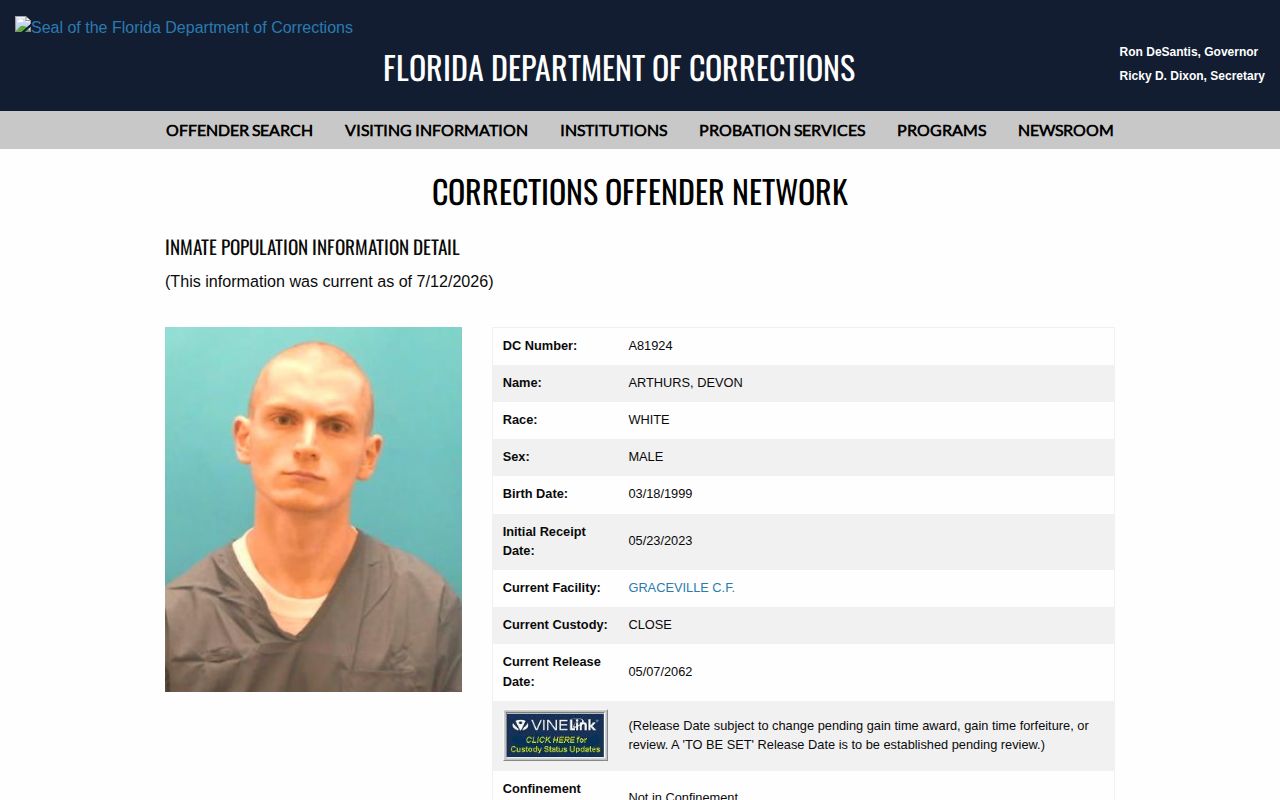
The screen confirms the public field name, while FDC's warning makes clear that true status, location, and dates can change quickly.
The broader St. Lucie County released inmate search helps distinguish a county release, state discharge, federal result, and court disposition once a date passes.
Note: A court release order may come before physical departure, so compare its date with the final jail or prison record.
Florida State Release Date Computation
A simplified FDC calculation starts with each court-imposed sentence. It accounts for whether multiple terms run at the same time or one after another. Court-awarded prior-custody credit is then applied. Only gain time allowed for that offense and offense date can reduce the computed term. A life sentence is not converted into an ordinary tentative date through gain time.
Florida Statutes section 944.275 requires a maximum sentence expiration date based on the imposed term less lawful credit. It also says the tentative release date cannot be later than that maximum. For the modern population governed by subsection (4)(b)3., subsection (4)(f) prevents gain time from causing release before 85 percent of the imposed sentence has been served. Physical jail credit awarded by the court counts toward that threshold.
The offense date matters. Basic gain time under an older statutory range does not apply to every modern sentence. Incentive gain-time exclusions also depend on the offense and date, including categories stated in the current law for offenses on or after July 1, 2023. Do not apply a simple percentage to a sentence and call the result official. FDC's calculation must reflect the actual judgment, credit, legal category, and correctional history.
The Florida Senate's statute page displays the tentative-date and gain-time rules used for a state computation.
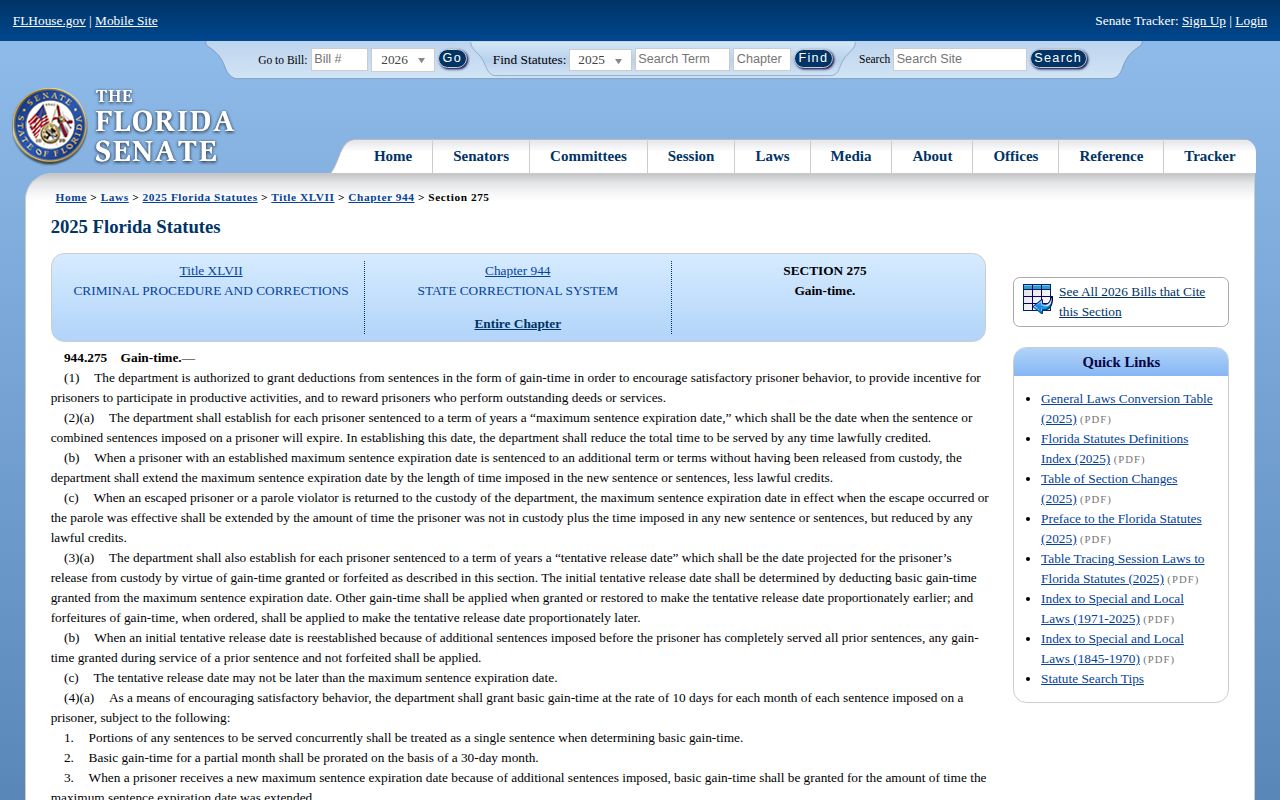
The statute supports the framework, but it does not calculate a named prisoner's date. The offender record and FDC remain the person-specific sources.
St. Lucie Jail Release Calculation
County-jail time follows different authority. Section 921.161 requires credit for time spent in county jail before sentence. The judgment should state that credit. A mistake or later correction in the court record can move the expected end date, which is why the jail calculation and judgment should be read together.
Section 951.21 authorizes county-prisoner good-conduct commutation unless the county commission revises or ends the policy. The statutory scale allows up to five days per month in the first and second years, ten days in the third and fourth years, and fifteen days in the fifth and later years. It also permits a locally adopted extra allowance of up to five days per month on a sheriff or warden recommendation.
Those amounts show legal capacity, not the actual St. Lucie award for a person. They do not prove the county's current policy or an inmate's conduct credit. Ask SLCSO for the maintained sentence and release calculation. Include the full name, date of birth, booking or inmate number, sentence date, and case number when known. Compare the result with the judgment rather than estimating from the statute alone.
A pretrial detainee does not receive a projected sentence date from this good-conduct law. The relevant events are bond or ROR, case disposition, a court order, and other holds. St. Lucie's Clerk pretrial status can show a date released and supervision details for a qualifying pending case, but the Sheriff's release timestamp is the physical-exit record.
St. Lucie Pretrial Release Timing
St. Lucie County's pretrial records provide a useful chain that a sentence calculator cannot replace. The Clerk's pretrial-status resource can show bond or release on recognizance, a date released, the case number, charges, and the next court date. The county Pretrial Program may supervise a defendant through enhanced supervision or electronic monitoring while the case remains pending. That person is released from jail, but is not on parole and may not have been convicted.
Pair the Clerk's legal event with the SLCSO physical release timestamp. A bond amount alone does not prove it was posted, and a release order alone does not show the minute jail processing ended. Another case or agency hold can also prevent community departure. If exact timing matters, use the Sheriff's public-records request for the existing booking and release record with a narrow date range, then verify each open case in the Clerk system.
Why St. Lucie Release Dates Change
A projected date is only as stable as the facts behind it. Some changes come from the court. Others come from lawful correctional credit or discipline. A hold can stop community departure without rewriting the end of the first agency's custody. Each factor should be traced to its own record.
| Factor | Possible effect | Where to verify |
|---|---|---|
| Corrected jail credit or sentence | Moves the calculation earlier or later | Court order and agency recalculation |
| Concurrent or consecutive terms | Changes how multiple sentences combine | Judgment, sentence history, and FDC |
| Gain time earned, lost, or restored | Adjusts the tentative state date within the law | FDC record |
| Offense exclusion | Limits or bars some incentive gain time | Statute, judgment, and FDC |
| Detainer or another agency hold | Can cause transfer rather than community release | Holding and receiving agencies |
| FCOR release action | Can establish or alter an eligible parole path | Written FCOR action and FDC record |
Probation does not ordinarily shorten a prison date by itself. A split sentence may place supervision after custody, and a Commission action may govern parole or another form of release. For most modern Florida prison cases, ordinary parole is not available. The current FDC date, sentence record, and any later order remain more reliable than a broad assumption about parole.
Note: A detainer can turn a scheduled release into a transfer, so the receiving agency must confirm the person's next custody status.
Confirm St. Lucie Release Near Date
Recheck the official source as the date approaches. For FDC, open the same offender detail and confirm the status, location, and Current Release Date. For St. Lucie County Jail, call the jail information line or request the maintained calculation and later release entry. For a pending case, review the Clerk docket and pretrial status, then confirm physical release with SLCSO.
Florida VINE can add a change alert. It may report release, transfer, escape, death, or out-to-court movements based on source data. The St. Lucie VINELink inmate search explains person matching and phone, text, or email registration. An alert can lag and is not formal proof, so save the final jail, FDC, or court record.
Check the destination whenever the person disappears from the first roster. FDC, another county, BOP, ICE, or a juvenile placement can follow local departure. “Not here” and “released home” are different conclusions. A strong confirmation identifies the person, the legal authority, the actual date, and the next custody or supervision status.
St. Lucie Release Date Terms
Small wording differences carry real meaning. Preserve the label used by the source instead of turning every date into “release day.” This keeps a prospective computation separate from a past event and prevents a custody transfer from being described as freedom from all control.
- Current Release Date
- FDC's public label for the current prospective date on a state inmate detail.
- Tentative release date
- The statutory FDC computation that can change and cannot exceed the maximum sentence expiration date.
- Maximum sentence expiration date
- The imposed term less lawful credit, calculated under state law.
- Actual release date
- The date the responsible agency records the end of that custody, which may be followed by transfer or supervision.
- Detainer
- A request or legal basis for another authority to take or continue custody after the first agency's release process.
When an official detail and a court order seem inconsistent, record both dates and contact the source. A corrected order may not yet be reflected online, or the agency may have another sentence or hold. The goal is not to choose the most favorable date. It is to find the record that currently controls and then verify the actual outcome.