
St. Lucie 24-Hour Release Source
The St. Lucie County Sheriff's Office does not offer a button or fixed page labeled as a 24-hour release list. Its official live release report covers a wider period. At the time researched, the table itself was titled “5 Day Release Report.” A reader seeking today's departures must compare each displayed release date and time with the start of the intended 24-hour period.
This is a release-first source for St. Lucie County Jail. It confirms when a person left Sheriff's Office custody, but the line alone does not establish that the person went home. A release can be a bond or recognizance departure, the end of a county term, or a handoff to the Florida Department of Corrections, another county, federal authorities, or immigration authorities. The destination matters.
Check St. Lucie Releases Today
Begin with a clear cutoff. If the check starts at 3 p.m., the same-day window runs back to 3 p.m. on the prior day. The Sheriff's report can be sorted by the release column, which makes recent entries easier to review. Do not assume every row shown belongs in that range because the live page retains several days of results.
- Open the live release report and note the current date and local time.
- Sort by the release column, then include only timestamps within the prior 24 hours.
- Match the full name and date of birth. Similar names should not be treated as the same person.
- Open the SLCSO inmate search for the booking detail while the recent record remains visible.
- Check the Clerk's case or pretrial status when the release appears tied to bond, recognizance, or a court order.
For a search focused on one named person rather than the day's full release stream, use the St. Lucie County released inmate search path. That route follows the case into the correct system if the county departure was a transfer.
Note: Save the official release timestamp and source date because the short public window changes as older entries age out.
St. Lucie 24-Hour Release Fields
The public report is concise. It gives enough information to identify a likely person and document the moment SLCSO recorded the release, but it is not a full booking or discharge packet. The field limits should shape any follow-up request.
| Field or control | What it shows |
|---|---|
| Name | The released person's name as displayed by the jail system. |
| Date of birth | An identity check that helps separate people with similar names. |
| Release date and time | The exact timestamp recorded for departure from SLCSO custody. |
| Record count | The number of entries currently returned in the report's wider live window. |
| Sort and print controls | Tools for ordering the table or retaining a working copy. |
The report does not show a booking number, photo, charge, bond type, release reason, or destination. Those points may appear in a booking detail, Clerk record, or an existing jail record obtained from the Records Custodian. A request should identify the person, date of birth, approximate booking date, and narrow release period.
The official five-day report shown in this capture displays the source's title, columns, and current table layout.
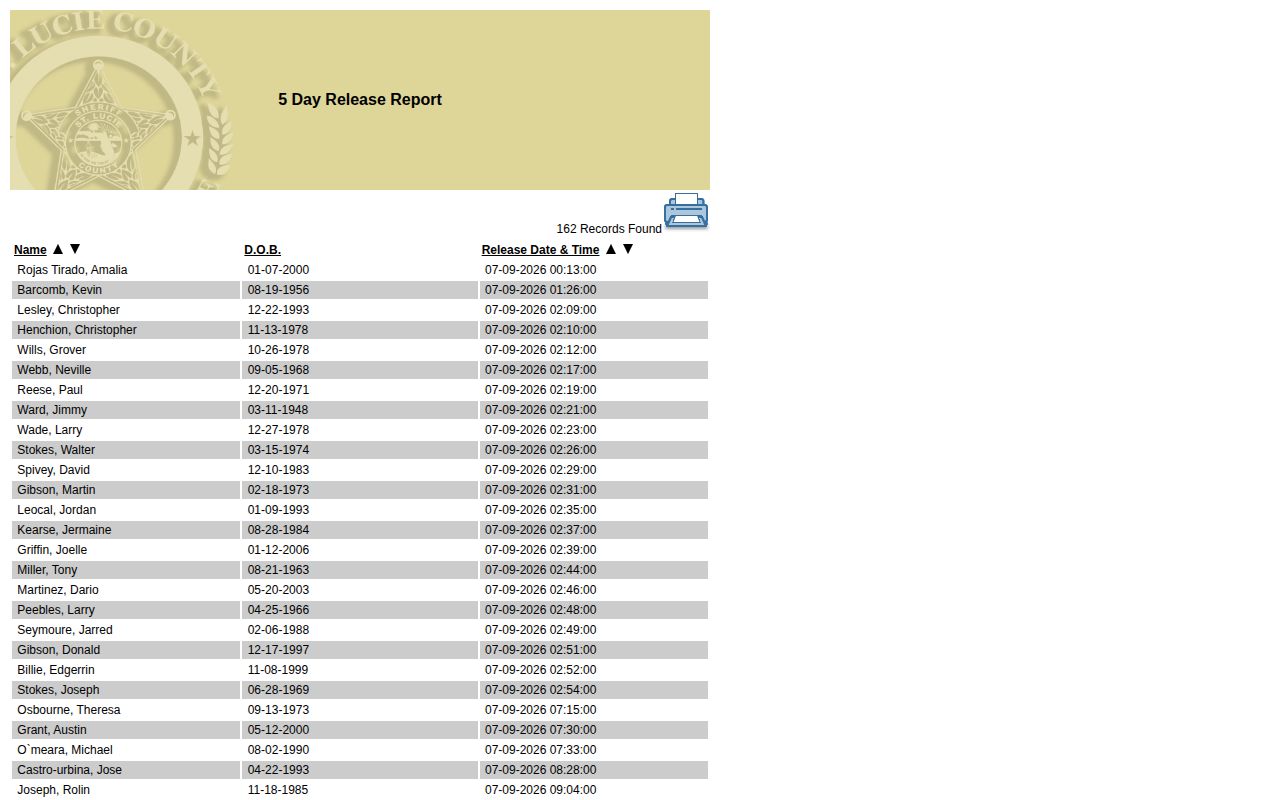
Its broader window explains why a true 24-hour list must be derived from timestamps rather than copied as a whole.
St. Lucie Pretrial Release Proof
A local court channel adds useful context to a same-day jail timestamp. St. Lucie County operates a court-ordered Pretrial Program for defendants awaiting disposition, including enhanced supervision and electronic monitoring. The Clerk's pretrial status resource can show whether a defendant was released pending trial, along with fields such as bond or release on recognizance, date released, case number, charges, and the next court date.
Pairing these records is stronger than relying on a bond amount. A posted amount does not prove that all conditions were met or that jail processing ended. The Sheriff timestamp addresses physical departure from county custody. The court or pretrial record addresses the legal status that follows. Pretrial release also means the case remains open unless the docket separately shows a dismissal or final disposition.
- Release on recognizance
- A court-authorized pretrial release without a cash or surety bond payment.
- Pretrial supervision
- Court-ordered monitoring while a case is pending outside the jail.
- Disposition
- The court event that resolves or changes the charge, not the jail's release timestamp.
St. Lucie Release Label Conflict
St. Lucie's official sources use conflicting labels for the same product. The Sheriff's navigation describes a “48 hour release report,” and the endpoint includes “48” in its name. Yet the live product renders “5 Day Release Report.” The main inmate search independently states that people remain searchable through five days post-release. No separate official 24-hour endpoint was found.
This conflict does not make the report unusable. It does mean the visible title and row timestamps should control the same-day calculation. Do not call the full table a Sheriff's 24-hour list. When exact completeness matters, request the existing jail release log for a specified start and end time. A bounded request is less ambiguous and avoids asking staff to create a new report.
No official SLCSO inmate or release app offering a broader same-day archive was identified in the reviewed Sheriff and app-store channels. An app should not be treated as an official source unless SLCSO links or endorses it.
The short web display is not the same as agency retention. Florida's GS2 schedule assigns a minimum retention of one anniversary year after release to booking records, commitment and release lists, and inmate incarceration records. Jail docket books are permanent. Those rules support a later records request, but they do not extend online access.
Note: The page URL and old navigation label do not override the five-day title currently rendered on the live report.
St. Lucie Release or Transfer
A person listed on the release report has left St. Lucie County Jail custody. That fact is narrower than release to the community. If the court committed the person to state prison, search the Florida Department of Corrections after intake. A federal sentence belongs in the Bureau of Prisons locator. A suspected immigration transfer belongs in the ICE custody locator, while a youth case belongs with authorized juvenile channels.
The current inmate roster answers a different question. It shows people still held and recently released records during the limited carryover period. Continued visibility after release is not proof that the person remains jailed. Likewise, disappearance from the live roster does not prove release home. The release timestamp, court docket, and destination agency must be read together.
| Situation | Best confirmation |
|---|---|
| Still in St. Lucie County Jail | Current SLCSO inmate record and jail confirmation |
| Released pending trial | SLCSO timestamp plus Clerk case or pretrial status |
| Transferred to FDC | FDC offender detail after state intake |
| Older county release | SLCSO records request plus the Clerk docket |
St. Lucie Release Record Fallbacks
When a same-day result is missing, wait for normal source updates if the need is not urgent, then check the jail by name. For an urgent court or safety need, call the jail. Once the short window closes, submit a public-records request to SLCSO for the existing booking and release record. Give exact identifiers and a narrow period.
VINELink can corroborate a custody change and provide alerts, but it is not the durable release authority. The Florida DOC search applies only if state prison or state supervision is involved. It does not fill a gap for someone who only bonded out of St. Lucie County Jail. The Clerk docket can preserve the court action for much longer, though a signed order may precede the actual release time.
An older St. Lucie County release is best reconstructed from records that answer different parts of the event. The Sheriff entry supplies the physical departure time. The criminal docket can supply the case number, charge history, disposition, judgment, or sentence. If state custody followed, the FDC detail supplies the state status and later release data. None of these sources should be forced to prove a fact outside its scope.
When writing the request, ask for an existing record rather than an explanation. A useful description is the booking and release record for the named person and date of birth, booked near a stated date, including any maintained release date, release time, release code, or destination. The public report does not promise that each added field exists or is open. The Records Custodian can redact exempt material and provide the nonexempt portion that the agency maintains.
For a broader recent look that can catch entries outside today's cutoff, compare the St. Lucie jail releases over 72 hours. Both windows come from the same five-day source and require careful timestamp filtering.