
St. Lucie 72-Hour Release Source
The St. Lucie County Sheriff's Office publishes a live release-first report, but it does not publish a distinct rolling 72-hour page. The official SLCSO release report currently renders a five-day table. To build a three-day view, set a cutoff exactly 72 hours before the time of review and keep only rows at or after that point.
This method is useful for catching releases across multiple days. It is still a user-defined window, not a Sheriff's product called the 72-hour release list. Calendar dates alone are not precise enough. A review at noon on Monday runs back to noon on Friday, while a midnight-to-midnight count would produce a different set. Record the time zone and review time if the result will support a records inquiry or court follow-up.
Check St. Lucie Three-Day Releases
A careful three-day review begins with the release column, not the name column. Sorting by time brings the relevant rows together. The reported date of birth then helps distinguish similar names. A release timestamp confirms that SLCSO custody ended, but additional sources are needed to learn why it ended and where the person went.
- Write down the current local date and time, then calculate the exact 72-hour cutoff.
- Open the live report and sort the release column in the useful direction.
- Review only entries within the bounded period and match names with dates of birth.
- Search the Sheriff's inmate database for a recent booking detail while it remains available.
- Use the Clerk case or pretrial status to identify a bond, recognizance release, disposition, sentence, or transfer order.
- Request a bounded jail log when a complete official range is required.
The official report is a stream of county-jail departures. It is not a statewide discharge list. Fort Pierce Community Release Center is part of the Florida Department of Corrections system, so the FDC offender record controls an actual state discharge from that facility.
Note: Use the exact same start and end times when comparing the web report with a later records response.
St. Lucie 72-Hour Release Fields
The five-day table contains a narrow set of public fields. Those fields support identity and time matching, but they cannot answer every release question. The table also offers sort and print controls, which help isolate a 72-hour slice without changing the official source.
| Displayed item | How it helps a 72-hour check |
|---|---|
| Name | Identifies the person listed as released from SLCSO custody. |
| Date of birth | Reduces the risk of confusing people who share a name. |
| Release date and time | Determines whether the row falls inside the chosen three-day range. |
| Record count | Shows the full result volume for the report's broader display period. |
| Sort and print controls | Organize timestamps and retain the reviewed table. |
No photo, booking number, charge, bond, release reason, or destination appears in this report table. A booking detail may add charge or bond information. The Clerk docket can show what the court ordered. An SLCSO public-records request can seek an existing booking sheet, release entry, jail log, or related nonexempt record for the person and period.
The Sheriff's name-search screen shown here states that records cover current inmates through five days post-release.
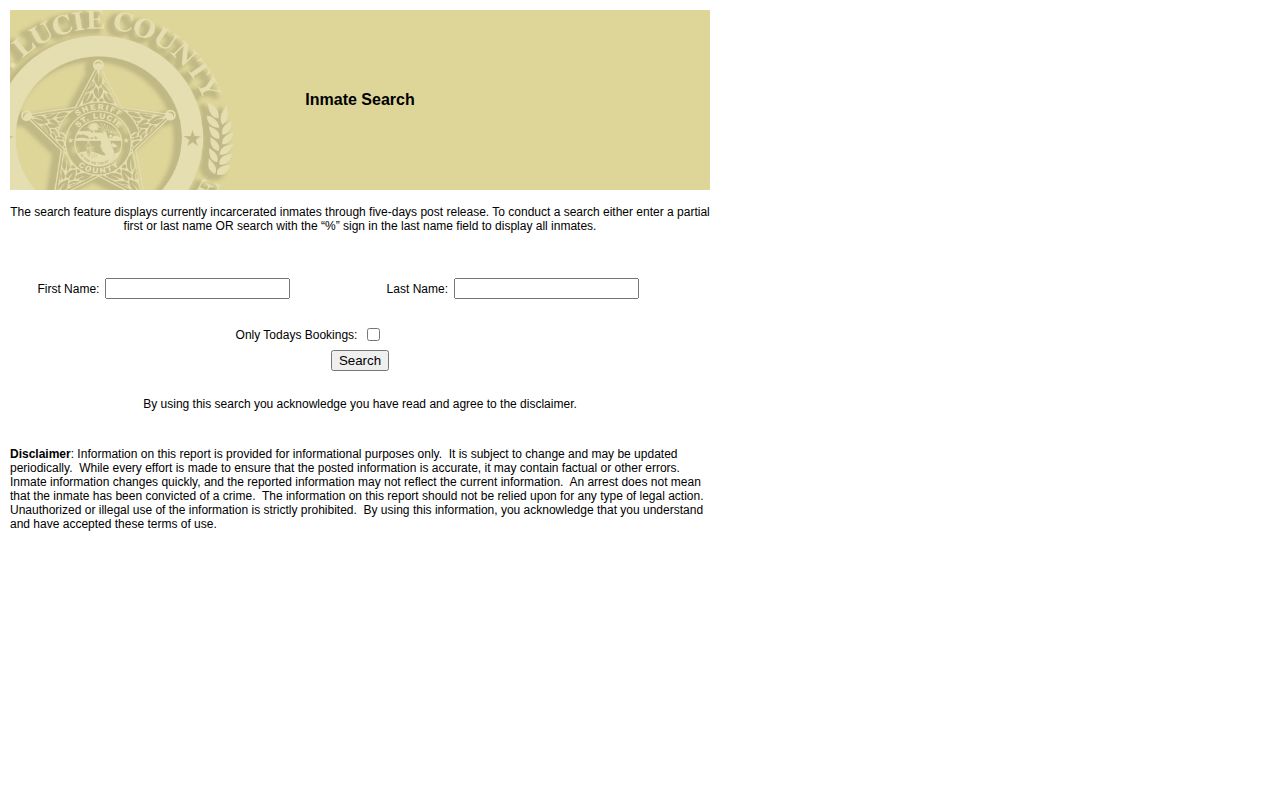
That carryover is useful for matching a three-day release row, but the recently released person's continued visibility does not mean current confinement.
St. Lucie Weekend Release Window
A 72-hour range is especially practical after a weekend or holiday because it spans more than one daily check. Research did not identify a fixed local release hour, a special weekend processing rule, or an official lag interval. It would be inaccurate to promise that every signed order appears in a certain number of minutes or that releases happen only at set times.
Physical release can follow the legal authorization. Jail staff may need to verify identity, check other holds, complete property and accounting tasks, and arrange the correct transfer or exit. The public report can also update after the actual custody event. A row that first becomes visible Monday may carry a Sunday timestamp and still belong in the chosen range.
A five-day source offers a useful cushion. If a three-day review begins after a delay, older rows may still be visible long enough to reconstruct the intended window. For a narrower same-day review, the St. Lucie jail releases over 24 hours apply the same timestamp method with a later cutoff.
St. Lucie Release Window Conflict
Three official clues must be reconciled. The Sheriff's navigation calls the product a “48 hour release report.” Its endpoint also includes the number 48. The live report itself says “5 Day Release Report,” while the main name search says it includes people through five days post-release. No distinct 72-hour feed or date selector was found in the reviewed Sheriff's navigation.
The safest description is a live multi-day report with a currently rendered five-day window and a legacy 48-hour label. A reader can derive 72 hours from its timestamps. If the precise population for a period must be complete, ask SLCSO for the existing release log bounded by exact start and end times. The agency need not create a new analysis or answer a broad narrative question.
The reviewed official channels also did not reveal an SLCSO inmate-release app with a separate three-day archive. A third-party app should not be described as a Sheriff source without a direct agency link.
Web visibility and records retention are separate. Florida's GS2 schedule gives booking records, commitment and release lists, and inmate incarceration records a minimum retention of one anniversary year after release. Jail docket books are permanent. The retention rule supports requests after the public display expires, but it does not mean the Sheriff's online search must show a year of results.
Note: Describe the full official table as five-day data, then identify the exact timestamps selected for the derived 72-hour window.
St. Lucie Release Status Paths
“Released” on the county table means St. Lucie County Jail no longer holds the person. A bond or recognizance release may place the person in the community while the case continues. Time served or county sentence expiration may end the jail term, though probation can follow. A transfer ends local custody but begins or continues custody elsewhere.
| Record clue | Meaning | Next source |
|---|---|---|
| Release timestamp plus bond or ROR | Likely pretrial release, with charges still pending | Clerk case and pretrial status |
| FDC commitment order | County departure was a state transfer | FDC offender search after intake |
| Federal or immigration hold | Another authority may have custody | BOP, ICE, federal court, or USMS as applicable |
| No recent web result | The short display may have expired | SLCSO records request and Clerk docket |
A current roster is for people still in the jail. Its five-day carryover also allows recently released records to remain searchable. Mere presence in that search is not proof of continued custody. Conversely, absence cannot prove release to the community because transfer and short-window expiration are other explanations.
Verify St. Lucie Older Releases
If the desired release falls outside the online window, start with the Clerk for an older county case. Most case records there reach much further back than the jail display and can identify the sentence, disposition, or agency commitment. Then ask the Sheriff's Records Custodian for the existing booking and release record with the person's name, date of birth, approximate booking date, and narrow release range.
VINELink can provide a current status or alert for a participating agency, but it is not the archival record. The FDC release search is appropriate only for a person sentenced to state prison. It excludes people sentenced solely to county jail or county probation. BOP covers sentenced federal offenders, while ICE's locator concerns current immigration detention and is not a historical release certificate.
The St. Lucie Clerk case search is valuable because its history lasts far longer than the Sheriff's recent display. A docket event can identify whether a judge set bond, ordered release on recognizance, imposed time served, dismissed a charge, entered a sentence, or committed the person to another system. It does not replace the jail's exact departure time. Matching both records reduces the risk of treating a signed order as proof that all release processing had already ended.
A bounded records request should name the person, supply the date of birth when known, and state the specific three-day period. Ask for the existing release log or booking and release entry, including the maintained timestamp and any release code or destination that is public. Do not ask the agency to compile a custom 72-hour analysis. The official table omits those added details, and their presence in a fuller record must be confirmed by the Records Custodian.
For a named person whose custody path is unclear, the full St. Lucie County released inmate lookup follows county, court, state, notification, and federal channels in order. That prevents a missing local roster result from being mistaken for proof that the person returned to the community.