
St. Lucie Juvenile Release Paths
St. Lucie Regional Juvenile Detention Center is a secure Florida Department of Juvenile Justice facility. Youth are held while awaiting adjudication, disposition, or placement. Adjudication is the juvenile-court process for deciding the case. Disposition is the court's order about what follows. Placement can mean movement into another DJJ program rather than return home.
A departure therefore needs a destination. A youth may be released to an authorized parent or guardian under a court order. Another youth may be transferred to a residential commitment program or another approved placement. The first can mean return to the community under stated conditions. The second means custody or placement continues in another setting.
| Possible departure | What it means | Authorized confirmation |
|---|---|---|
| Return to parent or guardian | The court or DJJ authorized release to a responsible adult | DJJ, juvenile court, counsel, or authorized guardian |
| Transfer to commitment program | The detention-center stay ended, but juvenile placement continues | DJJ case professionals and court order |
| Other court-ordered placement | The youth moves under a disposition or placement decision | Juvenile court and authorized DJJ contacts |
Confirm St. Lucie Juvenile Release
The correct search is not a public adult roster. Start with the person who has legal authority to receive case information. An authorized guardian can contact the facility or the assigned juvenile professionals. Counsel can read the controlling order and resolve legal questions. The juvenile court record, subject to access limits, can establish the adjudication, disposition, or placement authority.
- Confirm that the youth was held at this DJJ facility rather than an adult jail or another program.
- Gather the youth's accurate identity and case information without sharing it in public channels.
- Contact the assigned DJJ professional, counsel, juvenile court, or facility as an authorized person.
- Ask whether the departure was release to a guardian or transfer to another placement.
- Use the court or DJJ record that actually governs the youth's status.
A no-answer or no public result is not proof of release. Confidentiality may prevent disclosure to an unauthorized caller. It may also prevent a record from appearing in a public interface. The right response is to use lawful case channels, not to force a juvenile case into the St. Lucie County Jail report or FDC adult offender database.
Florida VINE includes DJJ in its state coverage and can provide a status or notification layer for eligible, properly registered users. It does not override juvenile confidentiality or replace the official court and DJJ case record. A status alert should be followed through the authorized source.
St. Lucie Juvenile Center Contact
The official DJJ facility page identifies the operator, location, service area, and phone. The center serves youth from St. Lucie, Indian River, Martin, and Okeechobee counties. Because more than one county is involved, the correct juvenile court and case professional may depend on the youth's case rather than the building's street address.
1301 Bell Avenue
Fort Pierce, FL 34982
772-241-6260
Florida Department of Juvenile Justice
Contact does not guarantee disclosure. Staff must apply identity, authority, and confidentiality rules. A parent or guardian should be ready to identify the relationship and case. Counsel or the juvenile court can address an order when facility staff cannot discuss the legal basis by phone.
The official DJJ facility page shown below is the matching government source for this center.
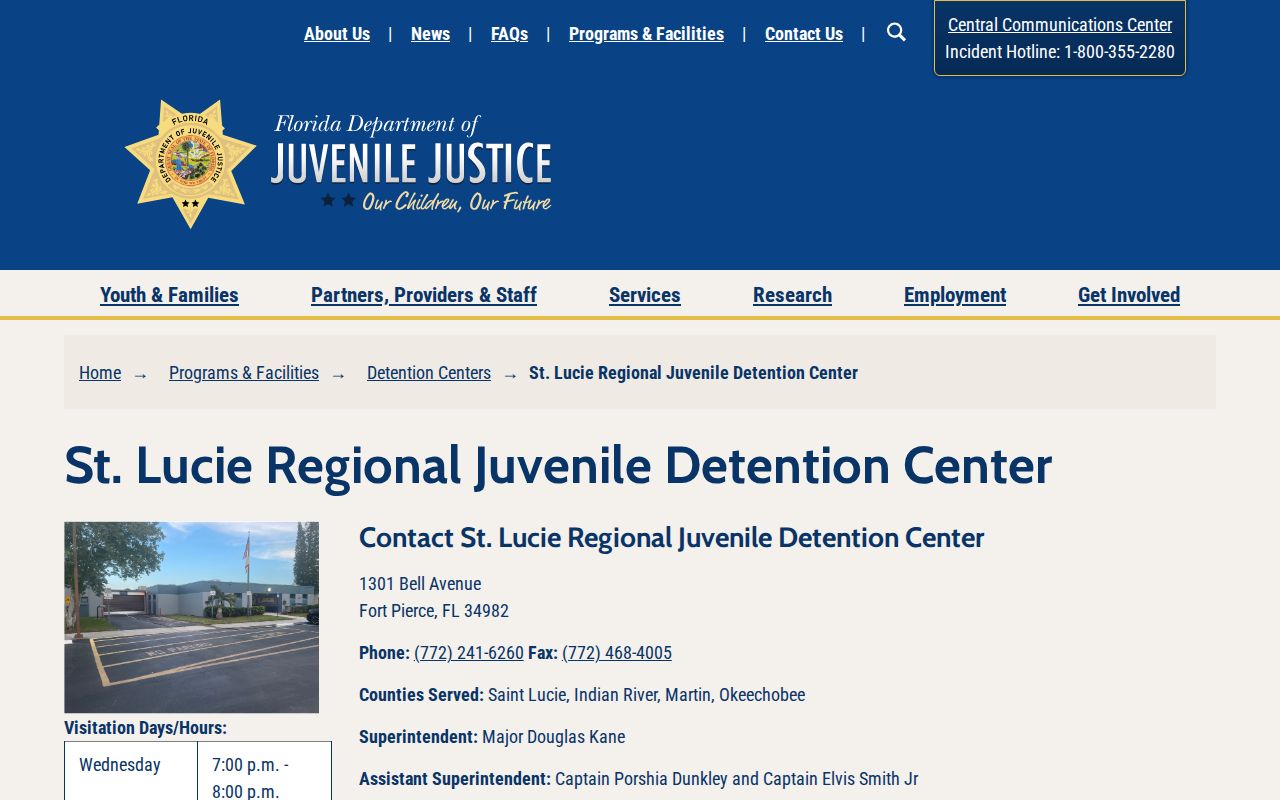
The capture supports the center's identity and facility context without exposing a youth's restricted case information.
Note: Facility contact is an authorized routing point, not a promise that a caller is entitled to a juvenile record.
St. Lucie Juvenile Facility Facts
DJJ describes the center as a 50-bed, hardware-secure juvenile detention facility owned and operated by the department. Hardware-secure means physical security features control movement. It is not the same as an adult county jail, and its residents should not be described as adult inmates.
The approximately ten-day average stay is descriptive. It does not predict when a named youth will leave. A case can move sooner or later based on court action, placement availability, legal status, and other case-specific facts. No average should be converted into a projected release date.
The four-county service area also cautions against assuming every case belongs in a St. Lucie County public court route. Indian River, Martin, and Okeechobee youth may be held at the same regional building. The assigned court and professionals remain the authoritative case sources.
St. Lucie Juvenile Record Limits
Florida public-record principles do not make every juvenile record open. The Sheriff's records guidance specifically recognizes juvenile information among material that may be exempt. Other protected data can include active investigative information, victim details, medical or mental-health information, biometric data, and security procedures. The custodian applies the governing restriction to each request.
An agency does not have to create a custom explanation or new report. An authorized person seeking an existing record should identify the youth and case, state the relationship or authority, and name the record needed. The response may be limited, redacted, routed to the juvenile court, or withheld when confidentiality applies.
Adult booking-photo practices are not a workaround. The SLCSO archived booking-photo route applies to adult local jail records and should never be presented as the way to obtain a youth's image. The same boundary applies to adult mugshot pages and adult state offender photographs.
The restriction also changes how a request should be framed. A public request for a list of youth released during a date range may reach protected case information and cannot be assumed available. A guardian seeking information about one child has a different position from a member of the general public. Staff or the custodian must determine what can be confirmed, which proof of authority is needed, and whether the juvenile court is the proper record holder.
- Confidential
- Protected from general disclosure under the applicable juvenile or records rule.
- Redacted
- Released with protected portions removed.
- Authorized person
- A guardian, counsel, case professional, or other person entitled to receive the specific information.
Juvenile Versus Adult Release Records
SLCSO's adult release report is not a youth locator. That report covers departures from St. Lucie County Jail and displays adult local-custody information during a short public window. FDC's adult Corrections Offender Network covers qualifying state prison and supervision records. Neither source establishes a release from this DJJ center.
| System | Population | Release route |
|---|---|---|
| St. Lucie Regional Juvenile Detention Center | Youth awaiting adjudication, disposition, or placement | Authorized DJJ, juvenile court, counsel, or guardian channels |
| St. Lucie County Jail | Adult local pretrial and qualifying county-sentence custody | SLCSO release report, booking record, and Clerk case |
| FDC state system | State prisoners and qualifying supervision cases | FDC offender, release, supervision, and records searches |
A youth can later enter a different program, but that new placement must be confirmed through DJJ and the case. Do not infer an adult state-prison transfer. The vocabulary also matters. Use youth, detention, adjudication, disposition, and placement when those are the official concepts.
St. Lucie Juvenile Release Follow-Up
Release to a guardian may include court conditions or services that are not visible to the public. Transfer to a commitment program means the secure detention episode ended, yet the youth remains in a formal placement. The controlling court order and DJJ case plan distinguish these results.
The case sequence matters. Detention holds the youth while adjudication, disposition, or placement is pending. A court action may authorize a new status before the physical handoff or transfer is complete. Facility staff and the assigned DJJ professionals coordinate the actual movement, while the order supplies its legal basis. For that reason, an authorized person should confirm both the controlling order and the completed placement or guardian handoff.
An authorized guardian should keep the names and contact details of counsel and assigned case professionals. Ask which order controls, where the youth is permitted to go, who will receive the youth, and which agency handles the next stage. Those are case-management questions for the responsible officials, not public roster searches.
The St. Lucie County custody-system overview can help identify whether a record belongs to the county jail, FDC, a federal authority, or DJJ. Once the matter is confirmed as juvenile, stop using adult paths and work only through authorized juvenile sources.
There is no documented public fixed release hour, public youth release feed, or open historical release list for this facility in the reviewed research. That absence should remain explicit. It protects accuracy and respects the access boundary instead of inventing a procedure.