
St. Lucie County Release Meaning
A St. Lucie County Jail release timestamp proves that SLCSO custody ended. It does not always prove a return to the community. The jail holds people awaiting court action, serving county terms, or waiting for another agency. A departure can follow bond, release on recognizance, time served, dismissal, sentence expiration, or a court program. It can also be a transfer to FDC, another county, a federal authority, or immigration custody. The destination determines which record controls next.
Released St. Lucie County inmates normally leave the active roster. The Sheriff's live report and five-day name search bridge the first days after departure. Older county cases move to the SLCSO records process and Clerk docket. State-prison release belongs in FDC. Federal sentence release belongs in BOP, while ICE ODLS addresses immigration detention. Court-ordered probation or another supervised term may continue after confinement ends. Read “released” as released from the named facility until another record establishes where the person went.
- Discharge
- The end of a defined correctional custody or supervision term.
- Time served
- A sentence satisfied through credited confinement.
- Detainer
- A request or hold tied to another authority.
- Recognizance
- Pretrial release without a cash or surety bond, subject to court terms.
Does a Sheriff release timestamp mean the person is free?
No. It proves that the SLCSO custody episode ended. A transfer record or receiving-agency locator is needed to rule out continued state, federal, immigration, or other local custody.
St. Lucie County Release Types
The reason county custody ends is not fully displayed in the public release table. Pair its timestamp with the booking profile, Clerk pretrial status, criminal docket, or requested release record. Each source answers a different part of the question.
| Release event | What it means | Next record |
|---|---|---|
| Bond or recognizance | The case continues outside jail under court terms. | SLCSO timestamp and Clerk pretrial or criminal case |
| Time served or county expiration | The confinement part has ended; supervision may follow. | Judgment, jail calculation, and supervision search |
| Dismissal or acquittal | A charge ended, though other cases or holds may remain. | Clerk disposition plus physical release timestamp |
| FDC commitment | County custody ended and state custody began. | FDC offender detail and receiving institution |
| Other authority transfer | The person left SLCSO but may remain confined. | Destination agency locator and transfer record |
| Probation, parole, or conditional release | Confinement ended while a supervision term continues. | FDC supervision detail, court order, or FCOR action |
Death also ends a custody episode but is not a community release. It should never be labeled as a person going home. The originating agency and official vital or investigative process control that record.
St. Lucie Release Record Fields
The public SLCSO report is a release-first list. It shows a name, date of birth, and exact release date and time. It does not show the photo, release reason, charge, bond, booking number, or destination. A profile can add booking and charge context, but one charge status such as dismissed, time served, closed, or pending does not establish the outcome of all cases or holds.
| Field | What it establishes |
|---|---|
| Name and date of birth | Identity clues that must be matched with other identifiers. |
| Release date and time | When the SLCSO custody episode ended. |
| Booking or inmate ID | A tie to the correct jail event when maintained in the fuller record. |
| Arresting agency and charges | Why booking began, not necessarily the final disposition. |
| Release code or authority | The maintained basis for departure, if it exists and is nonexempt. |
| Destination or receiving agency | Whether the person entered another custody system, if recorded and releasable. |
Ask for fields as maintained. Florida law does not require SLCSO to write a new narrative or promise fields that its system does not contain. The court record proves the legal order; the Sheriff timestamp proves physical processing ended.
Request St. Lucie Release Records
Once the five-day web window expires, use the SLCSO public-records portal. A narrow request for an existing booking and release entry is easier to identify than a request asking staff to explain what happened. Include a full name, date of birth, approximate booking date, and any inmate or case number.
- Confirm the person and approximate custody dates in the Clerk or other durable source.
- Request the existing booking and release record, actual release timestamp, and maintained release code or destination if nonexempt.
- Add the booking photograph only when needed and note that the posted fee is five dollars per image.
- Ask for an itemized estimate before charges exceed a set limit, and retain the portal key.
- Compare the response with the judgment, sentence, bond order, or receiving-agency record.
SLCSO lists possible deposits, staff-time, legal-review, certification, extensive-use, and payment charges. Its page does not promise a fixed turnaround. The Records Unit is at 4700 W. Midway Road, Fort Pierce, FL 34981, and its number is 772-462-3299. The Clerk's separate research process states two to seven business days; that estimate cannot be borrowed for Sheriff requests.
Florida Law on St. Lucie Releases
Florida Constitution article I, section 24 and section 119.07 support inspection and copying of existing public records, subject to exemptions, redaction, lawful fees, and special-service charges. Access is not absolute. Juvenile information, victim data, medical or mental-health material, active investigative information, security procedures, and sealed or expunged content may be restricted.
Florida's GS2 retention schedule gives booking records, commitment and release lists, and inmate incarceration records a minimum retention of one anniversary year after release, while jail docket books are permanent. Retention does not mean the record stays on the public website. The short online display can expire while an agency record remains requestable.
Sections 943.0585 and 943.059 govern court-ordered expunction and sealing. Eligibility turns on the disposition, prior record, offense, and statutory exceptions. The usual path starts with an FDLE Certificate of Eligibility, followed by a petition in the St. Lucie criminal case. A sealed or expunged history can remain accessible to entities named in law and does not force every independent publisher to delete a copy.
St. Lucie Pretrial Release Proof
St. Lucie County offers an unusually strong three-record chain for a bond or recognizance release. The Clerk's pretrial-status channel can show whether a defendant was released pending trial, with fields that may include bond or ROR, release date, case number, charges, and the next court date. The county Pretrial Program provides enhanced supervision and GPS or electronic monitoring when ordered. Neither source replaces the Sheriff's physical exit timestamp.
Start with the Clerk pretrial status resource, match the case, and then compare it with the SLCSO release report. A bond amount alone does not show that bond was posted. Pretrial supervision is not parole and does not imply a conviction. The court case remains pending unless the docket shows another disposition. This local pairing explains both why the person left jail and what court process continues.
Note: A pretrial release record concerns release pending case resolution, while FDC supervision concerns a state correctional sentence or release authority.
St. Lucie Property After Release
Jail property has a specific local route. The inmate must complete a property-release slip naming the authorized recipient under the Sheriff's jail property procedure. That person must show photo identification, and pickup is available Monday through Friday from 8 a.m. to 4:30 p.m. The separate Property and Evidence appointment page is not the channel for jail property. Calling the wrong office can delay retrieval after release.
State release documentation follows different law. Florida sections 944.605 and 944.705 address a digitized prerelease photograph and identification or release-document assistance for qualifying state inmates. Those state rules do not change SLCSO's property procedure. Confirm whether the person left county jail, a state institution, or a community release center before choosing the office.
St. Lucie Court Release Context
The St. Lucie Clerk Criminal Department divides records between Circuit Criminal for felonies and County Criminal for misdemeanors, criminal traffic, and ordinance cases. Its case search covers most cases dating to 1993 and can show parties, charges, docket events, sentences, costs, dates, and viewable documents. The separate pretrial archive adds release-pending-trial context.
Compare each charge and case. One dismissed or time-served count does not resolve other counts or holds. Look for bond modification, recognizance, dismissal, plea, judgment, jail credit, probation, FDC commitment, and termination entries. A certified order proves what the court directed. The Sheriff report shows when jail processing actually ended. Together they explain both authority and physical departure.
St. Lucie Release System Scale
SLCSO's dated 2022 annual report counted 7,604 bookings, an average daily jail population of 1,212, and an average care, custody, and control cost of $80.81 per inmate per day. These are not release totals and bookings are not unique people. They show the scale of the custody system without predicting the status of a named person.
The county's 2024 annual report also listed 720 pretrial defendants supervised and 6,366 field or residence checks. Those figures describe a release-pending-trial system, not post-prison parole. Dates and labels must stay attached to every statistic.
Find Released St. Lucie Inmates
Work outward from the last known custodian. Searching only the active jail roster cannot answer where a released or transferred person went. Use identifiers across sources and preserve the exact status wording.
- Check the SLCSO release report and record the name, date of birth, and release timestamp.
- Search the SLCSO name database, which covers current inmates through five days after release. Presence there is not proof of current custody.
- Open the Clerk criminal case and pretrial status to identify bond, dismissal, sentence, probation, or commitment.
- Search FDC release and supervision databases if state prison or state supervision is possible.
- Use VINELink for participating-agency status and alerts, then corroborate the result.
- Check BOP, ICE, or federal case channels only when the case or hold points there.
- After the web window expires, request the existing SLCSO release record with a narrow date range.
For an older county case, the Clerk's history is often the best starting point because most cases date to 1993. For an older state-prison case, start with the FDC release search and six-character DC number.
FDC St. Lucie Release Search
The FDC Inmate Release Information Search covers people released from Florida state prison. It excludes people sentenced only to county jail or county probation. Search by the six-character DC number when known. Otherwise use the start of a first or last name, aliases, photo choices, and result limits. Match the DC number, demographics, offense county, sentence, and history before selecting a record.
- Choose the released-prisoner database, not the current-inmate-only search.
- Enter the DC number or the strongest verified name information available.
- Compare aliases, demographics, offense county, sentence history, and photograph.
- Read Release Date and Date Out-Custody, then check the supervision database separately.
| Search field | Use | Caution |
|---|---|---|
| DC number | Best state identifier | Six characters; do not substitute a county booking ID. |
| First and last name | Find records when the ID is unknown | Common names require more matching. |
| Aliases | Include former or alternate names | Verify identity independently. |
| Photo filters | Show, suppress, or limit images | A face alone is not a match. |
| Release and out-custody dates | Document state-prison departure | Check supervision separately. |
The released detail can show Release Date and Date Out-Custody. A current-inmate page uses Current Release Date for a prospective date. FDC warns that status and dates can change.
This official captured search illustrates the state route for St. Lucie County prisoners who entered FDC:
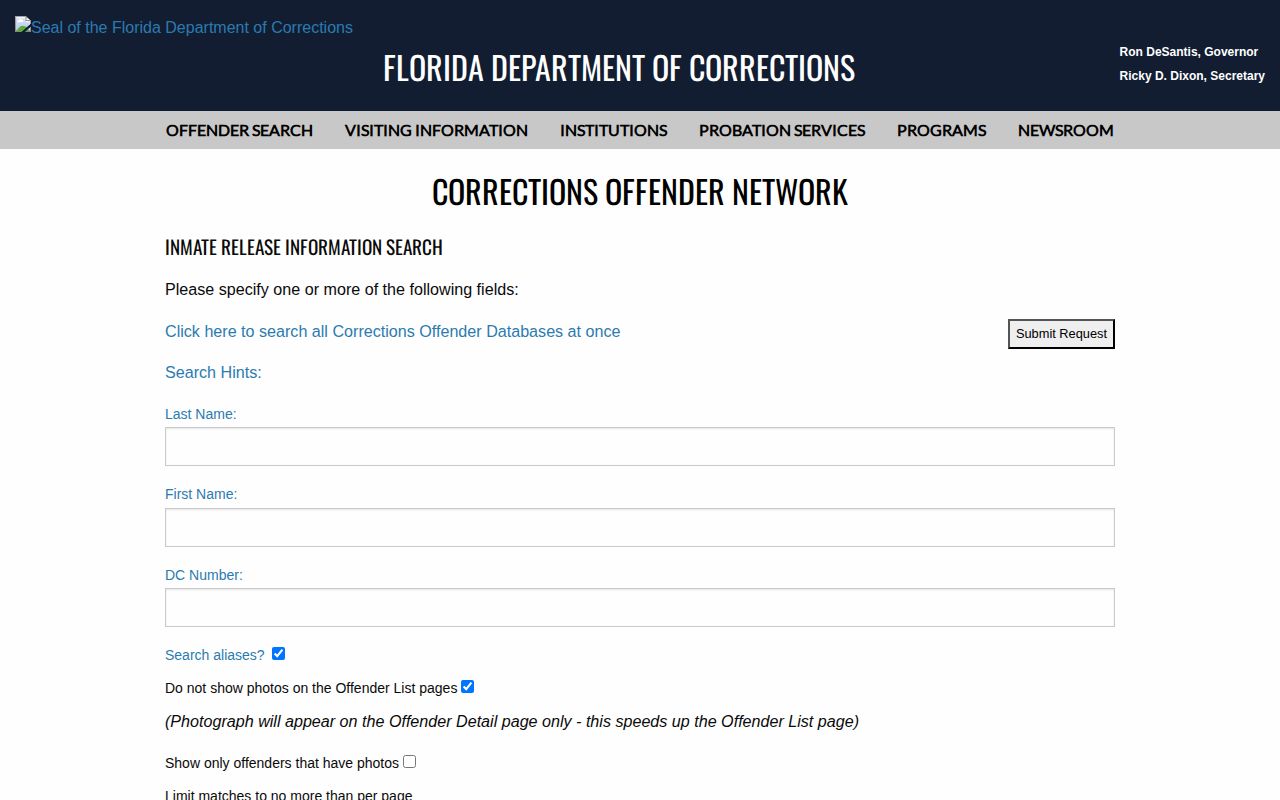
The state page should not be used to fill the Sheriff's county-only five-day gap.
St. Lucie Recent Release Report
SLCSO publishes a release-first report whose endpoint and navigation retain a “48 hour” label, while the live product currently says “5 Day Release Report.” The general inmate search independently says people remain searchable through five days after release. There is no distinct official 24-hour or 72-hour selector. Readers must isolate those windows from the exact timestamps or request a jail log bounded by precise start and end times.
The report shows name, date of birth, release date and time, record count, and sort or print controls. It omits the photo, release reason, charges, bond, booking ID, and destination. SLCSO publishes no guaranteed refresh interval. A newly processed entry can lag, and a transfer can look like a release from the county system. The live report shown below documents the displayed window and fields:
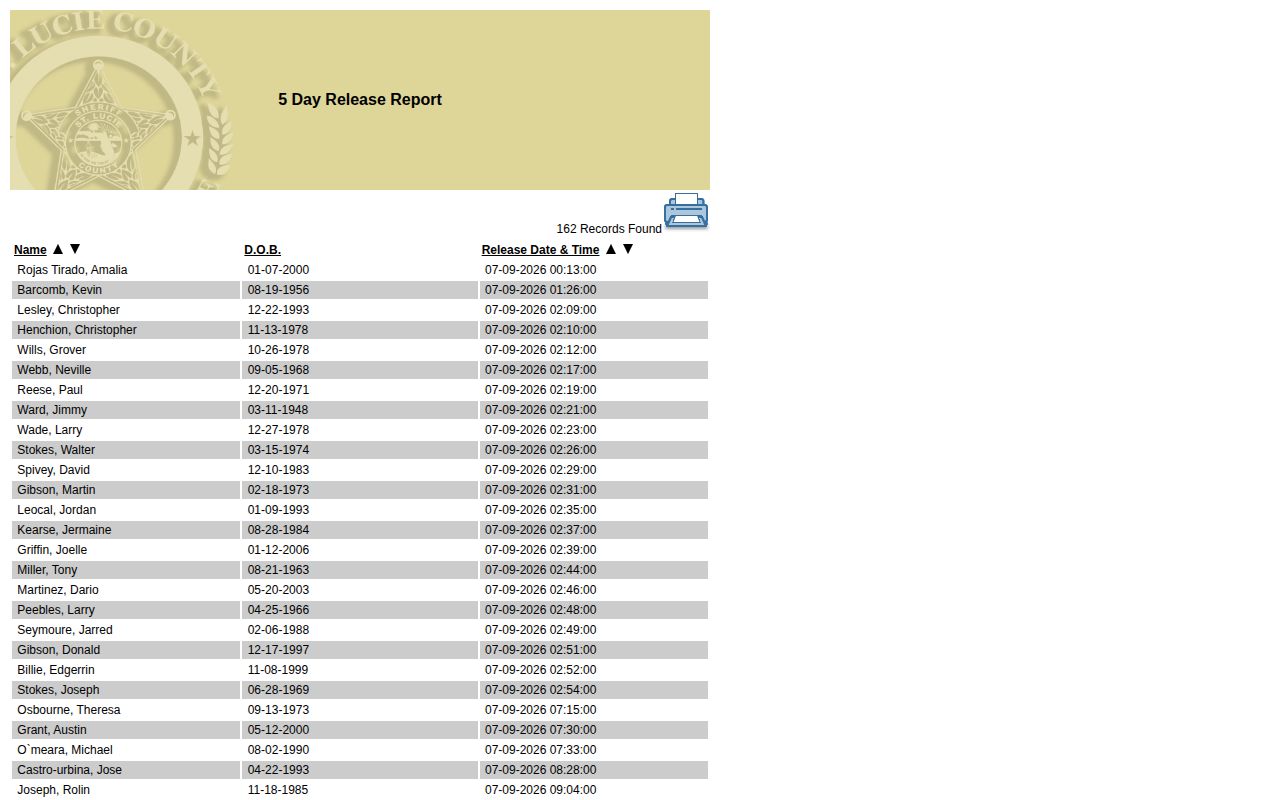
The rendered title should control over older navigation text, while the conflict remains disclosed.
St. Lucie Release Supervision
Release from confinement does not always end correctional control. Probation is usually imposed by a court and can start without prison. Parole is discretionary release under the Florida Commission on Offender Review for a limited eligible population. Conditional release and community control are different forms. FDC performs day-to-day state supervision, while FCOR makes parole and certain release decisions.
Search FDC's supervised-population database by DC number or name, then read the supervision type, dates, and office. County probation or a court order may require the Clerk docket because not every local term appears in the FDC database. The Ft. Pierce Circuit Office serves St. Lucie and three neighboring counties. Its listed intake office is at 2806 South U.S. Highway 1, 772-468-3933, and Fort Pierce East is at 3214 South U.S. Highway 1, Suite 7, 772-468-4064. Reporting instructions come from the assigned officer, not a web result.
St. Lucie Reentry After Release
The Public Defender for the Nineteenth Judicial Circuit operates a voluntary Offender Re-Entry Program. It develops individualized plans for eligible county-jail participants and says services can also reach people returning to the circuit from FDC. Treatment and post-release coordination are support services, not custody locators or proof of discharge.
Fort Pierce Community Release Center creates a second local distinction. A person authorized to work or take part in programming outside that building remains in FDC custody. The phrase “community release” in the facility name does not mean the state sentence has ended. Verify discharge through the FDC status, release fields, and supervised-population record. This distinction is critical when reconnecting with a person whose daily movement looks like freedom but whose legal custody has not ended.
St. Lucie Release Alerts and Transfers
Florida VINE covers FDC, DJJ, and participating county jails. Search a verified person, match identity and facility, and read the reported custody status. Register for phone, text, or email notifications when offered. A VINE released result corroborates a source-agency change but does not explain whether another authority assumed custody. Direct VINE registration is also separate from FDC Victim Services registration.
For a federal sentence, use the BOP Inmate Locator, which covers federal offenders from 1982 onward and may show Released or Not in BOP custody with a date. A USMS pretrial detainee may be housed under contract and require the federal case, counsel, or USMS. ICE ODLS locates current immigration custody and is not a historical release certificate.
ICE Transfers After St. Lucie Release
SLCSO signed a 287(g) Warrant Service Officer agreement with ICE in February 2025. ICE describes that model as authorizing trained local officers to serve and execute administrative warrants on people already in local custody. The agreement does not make St. Lucie County Jail an ICE detention center.
It does make destination verification essential. A Sheriff Released timestamp can precede transfer to immigration custody. Search the ICE Online Detainee Locator System by A-number and country of birth or exact biographical details when the record suggests an immigration hold. A no-result remains inconclusive because spelling, intake delay, protected data, transfer, or release can all explain it. Request the maintained destination field from SLCSO when appropriate and nonexempt.
Florida Archive for St. Lucie Releases
FDC's downloadable OBIS data provides a state-level archive beyond a rolling county roster. Separate released-inmate tables cover basic data, aliases, current and prior offenses, detainers, and incarceration history for people released since October 1, 1997. FDC says the cohort updates monthly and excludes sealed, expunged, and confidential data.
OBIS applies only to the state correctional population. It cannot establish a release for someone who merely bonded out of St. Lucie County Jail. The FDLE registry has another narrow status, Released - Subject to Registration, for qualifying registrants whose confinement or other sanction ended while a statutory registration duty remains. That label must never be generalized to people without such a duty.
Compare St. Lucie Custody Records
Choose the source by system and time. A name missing from one roster is not proof of release to the community.
| Situation | Primary source | What it proves |
|---|---|---|
| Current or very recent county jail case | SLCSO name search and release report | County custody or exact county departure |
| Older county case | SLCSO request and Clerk docket | Maintained release entry and legal event |
| State prison or supervision | FDC offender searches | State status, discharge date, and supervision |
| Federal sentence | BOP locator | BOP custody or released wording |
| Immigration custody | ICE ODLS | Locatable current ICE detention |
| Juvenile matter | Authorized DJJ or juvenile-court channel | Restricted status for an authorized person |
St. Lucie Release Facilities
The three mapped facilities use different record systems. Choose the route that matches the operator and the person's legal status.
- St. Lucie County Jail is the adult local facility. Bond, court programs, county sentence completion, and transfers can all end SLCSO custody.
- Fort Pierce Community Release Center is an FDC placement. Community activity is still state custody until the FDC record shows discharge.
- St. Lucie Regional Juvenile Detention Center holds youth pending adjudication, disposition, or placement. Adult public search paths do not establish a youth's release.
No BOP prison or ICE detention center was identified inside St. Lucie County. Transfers into federal or immigration custody can still occur and must be checked in the receiving system.